
Read the New York County Property Tax Record Snapshot
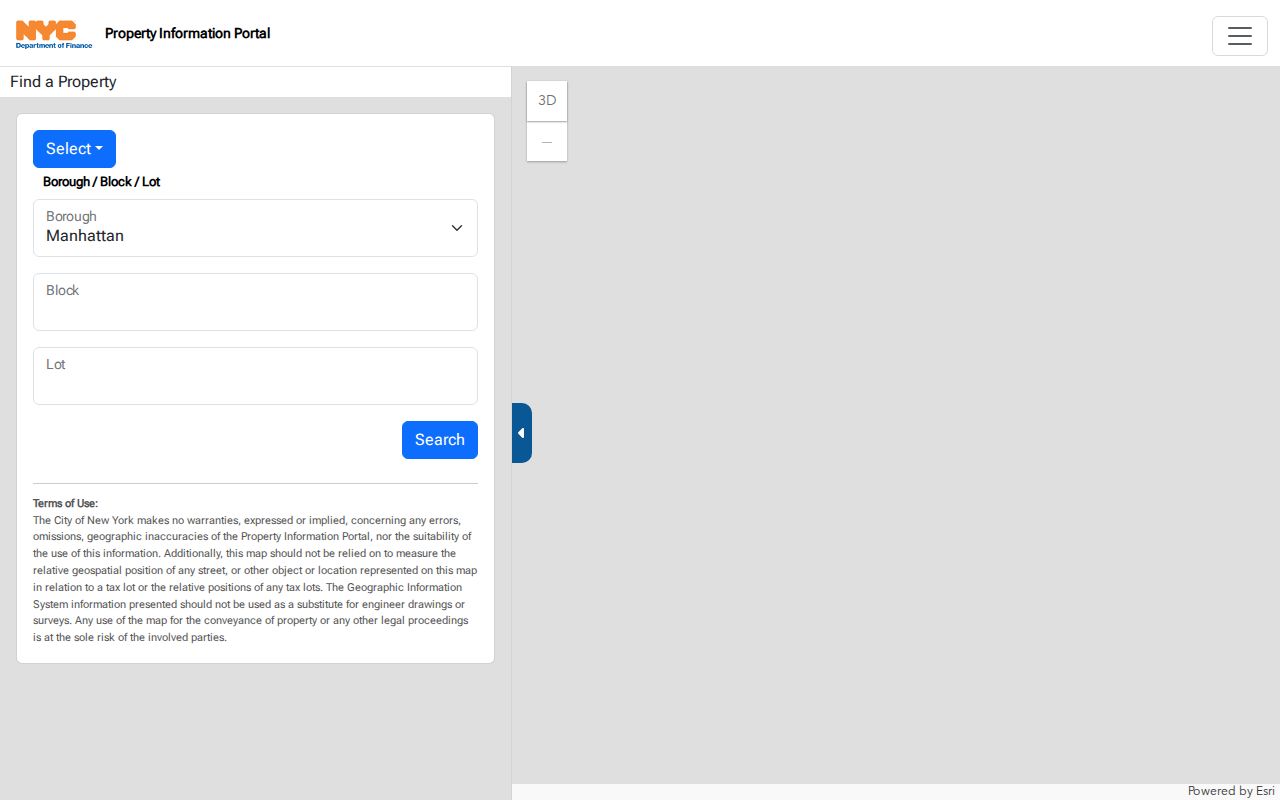
Begin at the Department of Finance Property Information Portal. Search the address and save the borough-block-lot number. From there, open the Property, Assessment, Exemption, and tax-bill records in turn. PIP names the tax-record owner and tax class. The annual tentative and final rolls supply the official assessment snapshot. A tax record is not a deed, and its update cycle can differ from ACRIS.
| Tax record | What to read | Why it matters |
|---|---|---|
| Property card | Owner, type, class, BBL | Identifies the account |
| Assessment history | Land, improvement, total, change | Shows ten-year value history |
| Exemption card | Code, exempt AV, taxable AV | Explains reductions |
| Tax bill | Charges, credits, balance, due date | Shows what is payable |
Separate Manhattan Market, Assessed, and Billable Values
DOF market value is an administrative estimate for assessment purposes, not an appraisal of what a buyer would pay. Assessed value comes next. The statutory level is generally 6 percent for Class 1 and 45 percent for Classes 2, 3, and 4, subject to caps and transitional rules. Exemptions then shrink taxable assessed value. What remains is the taxable billable value. That is the figure the bill calculation uses. None of these numbers is a market price by definition. PIP history can display fiscal year, building and tax classes, land and improvement values, total assessed value, and percentage change for up to ten years, so compare like fields and like fiscal years rather than mixing a tentative roll with a later final value.
Find Manhattan Property Tax Bills and Due Dates
DOF bill records show current and past-due amounts, charges, credits, exemptions, and payment details. Quarterly bills generally go to properties assessed at $250,000 or less, while larger accounts are generally billed semiannually. Trust the due date printed on the current bill. An assessment page cannot settle the balance. Names deserve caution too. Deeds and tax accounts move on separate schedules. When the name matters, compare the PIP Property Owner with the newest ACRIS grantee and note the access date for each source.
Understand Exemptions in New York County Property Tax Records
The PIP exemption card lists the fiscal year, exemption code or type, exempt assessed value, and taxable assessed value. An exemption only trims taxable value. It cannot rewrite a deed. It cannot change a recorded sale amount either. Because several exemptions or abatements may work in different ways, rely on the named field instead of subtracting an unexplained number. Cooperatives add a wrinkle. In a Chelsea development, for example, the billing parcel and the resident's unit interest require extra care, and a large condo billing BBL will not behave like a one-family Class 1 lot.
Review a Manhattan Assessment
DOF offers Request for Review, Request to Update, and administrative-review forms. The NYC Tax Commission runs its own petitions and addenda. Filing deadlines differ by class. The 2026 calendar sets March 16 for Class 1 and March 2 for Class 2. Class 4 DOF review filings fall on April 1. Current instructions always control. A Tax Commission application can carry separate forms, evidence, fees, and deadlines. Check both routes on the official DOF assessment-forms page.
Match the procedure to the claimed error instead of treating every correction as a valuation protest.
Read Delinquency and Lien-Sale Notices Carefully
Unpaid eligible charges can enter the City's notice and lien-sale process, picking up interest and surcharges along the way. A lien sale transfers a collection right. The purchaser does not instantly get title. Current DOF and DEP materials govern the details, including notices, eligibility thresholds, excluded or protected situations, later charges, and foreclosure risk. Each record answers a different question. County Clerk judgment and lien records, ACRIS property documents, and the DOF tax account should never be conflated. Search each only when the issue calls for it.
Use Tax Maps to Explain a Manhattan Account
Tax maps locate the BBL, and in PIP they can show lot changes, effective dates, and alteration history since May 2008, which explains why a tax roll references a parcel differently from an older deed. CityMap, ZoLa, and MapPLUTO add context. They bring geography, zoning, land use, and landmark layers to the same account. No administrative GIS map is a boundary survey.
Limits of New York County Property Tax Records
A tax roll measures property for taxation. Nothing more. It does not certify title, promise a sale price, prove a legal boundary, or show every pending charge at all times. Save the BBL, fiscal year, roll status, tax class, values, exemptions, bill date, and access date so another reader can reproduce the conclusion.
Keep the records distinct. Assessment establishes a tax value, the bill establishes charges, and ACRIS records conveyances and related documents.
Preserve Manhattan Tax Record's Time Context
Assessment history in Manhattan is really a chain of dated administrative decisions. Read the same field across fiscal years. Note whether each roll is tentative or final. Land and improvement values can move in opposite directions. One percentage jump may trace back to new construction, a correction, a cap, or a transitional calculation. It never translates cleanly into market appreciation.
The bill adds its own time layer. Charges, credits, exemptions, interest, and payments can all post after the valuation date. Check any past-due amount on the current account. Do not reconstruct it from an old assessed value. If a lien-sale notice is involved, keep the notice date and debt type. Then confirm current status with DOF or DEP.
An appeal file should match the remedy being requested. An owner update, a factual account error, and a valuation challenge are distinct claims. DOF review routes and a Tax Commission petition can call for different forms and proof. Record the tax class and the assessment year. Note the form version, the deadline, and the submission confirmation.
A parcel alteration may explain a new BBL series on the roll. ACRIS can then show the instrument tied to that change. Keep parcel-history evidence beside the roll. Do not assume a new account erased the earlier tax and ownership story.
Tax class supplies essential context. Class 1 commonly covers one- to three-family homes. Other residential, utility, and commercial property follows different assessment treatment. Verify the class on the subject account rather than inferring it from a building's appearance. A converted structure may not behave like the house next door. A condo unit, a vacant parcel, or a development billing lot may not either.
For a reproducible tax summary, list the BBL, fiscal year, roll status, market value, and assessed value. Include taxable assessed or billable value, exemptions, bill date, amount due, and access date. If a deed-owner mismatch appears, add the latest ACRIS grantee and recording date. Do so without altering the tax record's wording. That way a reader sees an update-cycle issue instead of one blended, unsupported owner statement.
Retain the actual bill or roll page you used, not just a handwritten total. The original layout shows the account, period, credits, and labels. These explain how the number was derived and whether it stayed current.