
Choose a New York County Address, Owner Name, or BBL
Every New York County property search leans on the strongest key available. Pick accordingly. For an ordinary lookup, use an address in PIP. For an exact tax lot, use the BBL. When the only clue is a person, trust, or business name, turn to the ACRIS party index. PIP offers no standalone owner-name search; its address or parcel result shows the tax-record Property Owner, while ACRIS covers names attached to recorded documents.
| Starting key | First official tool | Result to save |
|---|---|---|
| Street address | PIP autocomplete | Manhattan BBL and owner field |
| Owner or LLC | ACRIS party search | Role, CRFN, parcel, date |
| BBL | PIP and ACRIS parcel searches | Matching tax and deed records |
Walk Through the New York County Property Search
Type the street number and name into PIP and select the suggested New York City address. Confirm the borough is Manhattan. Record the borough 1 BBL before reading anything else. Check Property Type and Tax Class against what stands on the ground. Then open the other cards. Building and Land holds dimensions and basic facts, Assessment shows annual values, Exemptions lists reductions, Sales covers transfers, and Documents collects recorded instruments.
- Resolve the address in PIP.
- Save the BBL and Property Owner entry.
- Search that BBL in ACRIS.
- Sort the deed results by the newest relevant recording.
- Check CityMap and DOB systems when location or work history matters.
The PIP search screen shows all supported parcel types.
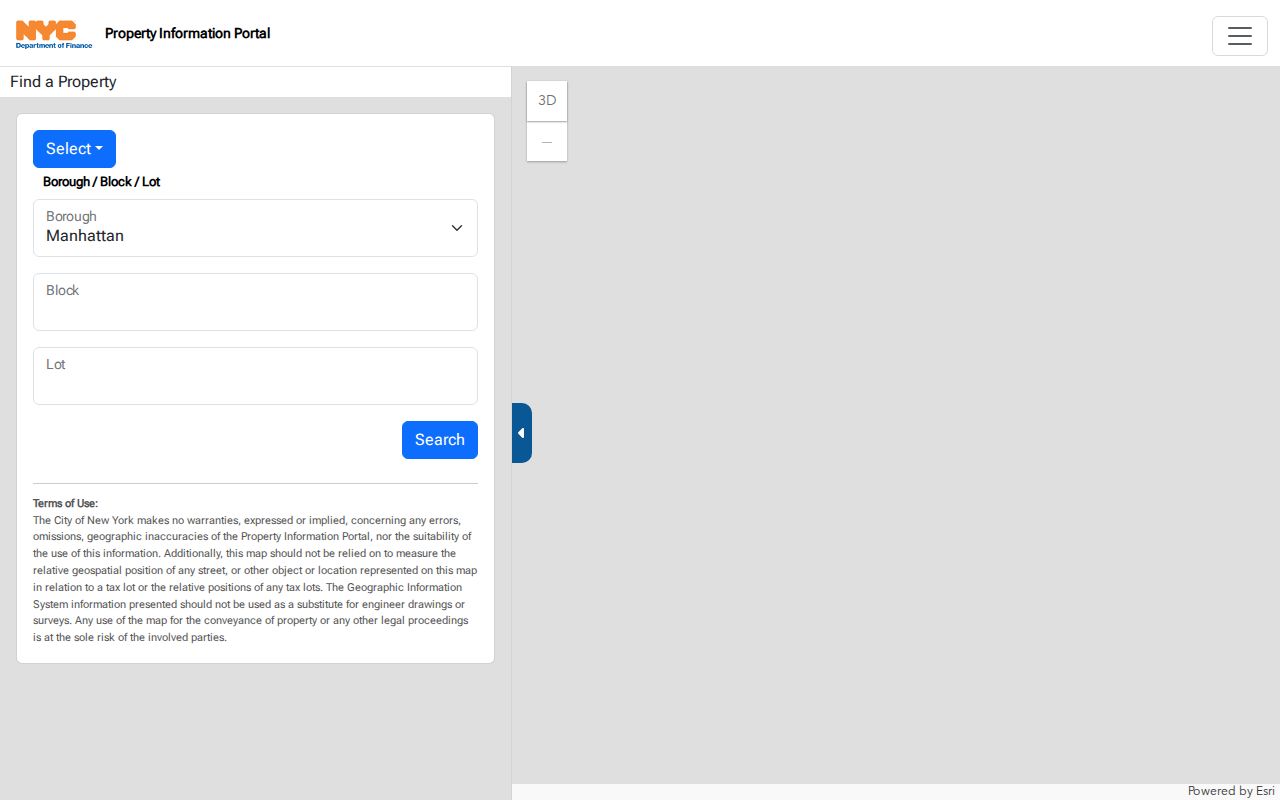
These options prevent mix-ups. Condo, co-op, air-lot, and subterranean-lot settings keep a specialized interest from being read as a plain ground lot.
Read Manhattan Property Owner Field With Care
The Property Owner label belongs to the Department of Finance tax account. Treat it as a current snapshot. It is not a title opinion, and roll updates follow no fixed interval after a deed records. After a recent sale, compare it with the newest ACRIS deed. Note the grantee, document date, recording date and time, CRFN, and BBL. Note the date of each check.
A mailing address may differ from the situs address. A trust, estate, nominee, or LLC may appear instead. A mortgage party is not always an owner. That is why document role and type matter more than any name appearing in a result.
Run an Exact Manhattan BBL Through ACRIS
ACRIS splits a parcel search into borough, block, and lot. Manhattan is borough 1. Lot 0000 returns block-wide records, and co-op work can use the optional unit field. Date-range and document-class filters cut the noise. Where a tax lot merged or split, search the former lots and study document references and tax-map history. The official parcel-search help illustrates these exact fields.
Copy the BBL straight from PIP or CityMap first. The screen works best that way.
Search a Manhattan Owner or LLC in the Party Index
ACRIS gives individuals last name, first name, middle initial, and suffix fields. Organizations go in the business field. Filters cover date range, party type, borough, and document class. Try sensible name variants. Inspect the party's role. It may be grantor, grantee, lender, borrower, assignor, or other. Then confirm the linked parcel. The ACRIS party-name guide displays the individual and business routes.
Entity names can also be cross-checked in the New York Department of State business database. That filing address proves nothing about ownership.
Interpret Manhattan Sales and Document Rows
PIP lists recent sales and recorded documents in a quick view. ACRIS carries the fuller index detail. Note the document type, amount, parties and roles, document date, recording date and time, CRFN, BBL, and any references or corrections. A stated amount may not equal open-market value. A mortgage amount is not a sale price. The ACRIS detail guide identifies the fields returned for a chosen document.
Follow the paper trail. Referenced instruments reveal corrections, releases, and the transaction's place in the chain of title.
Use BIN, BIS, and DOB NOW After the Parcel Match
A BIN identifies a building. A BBL identifies a tax lot. BIS searches run by address, block and lot, BIN, complaint, 311 reference, and violation number. DOB NOW separately offers address, BBL, BIN, job-number, device, licensee, and violation searches. Check both systems. Building jobs, violations, complaints, and certificates of occupancy add regulatory history, not title proof.
Resolve Historic and Ambiguous Manhattan Addresses
When autocomplete returns nothing useful, try the BBL, former street names, old lot numbers, the legal description, and block-wide ACRIS lot 0000. Historic addressing matters in Manhattan. Older deeds may carry former street names, distances from intersections, liber and page citations, farm lines, or lots that predate today's BBL. Instruments from before 1966 require the Land Records Research Library and may point to earlier county indexes.
A PIP sample can legitimately return an unpopulated card. That is a cue, not a verdict. Move on to ACRIS, CityMap, counter records, historic tax maps, and the library. The parcel still has history.
What a New York County Property Search Cannot Prove
Names alone can mislead. A tax owner cannot establish complete ownership by itself. The same goes for one deed, a GIS outline, a directory entry, or a business filing. Unrecorded interests and name collisions can skew a result. So can fiduciary transfers, redactions, map changes, and recent filings. So end with a worksheet. List the BBL, access date, PIP owner, latest deed and grantee, and discrepancies. Note documents still needed. That closing habit turns a quick lookup into a genuine New York County property search.
Search limit. Official indexes support research and due diligence, but they do not replace a title examination, certified record, appraisal, or licensed boundary survey.
Share the conclusion alone and it can mislead. Keep the query terms and the source dates with any result you pass along. That small audit trail helps a later reader tell a real record change apart from a spelling choice, a filtered search, or a different parcel.
Documenting a New York County Property Search
Some patterns deserve a second pass. A life-estate deed splits present interests from future ones. An executor can sign on behalf of an estate. A trustee acts in a representative role, and a trust name may not match between the tax and deed systems. An LLC can rename or merge without much notice. Search each party in the correct ACRIS field, then keep the role, document class, and parcel attached to every result.
Older addresses need care. Before assuming a historic street and a modern BBL describe the same land, compare the current tax map with the alteration history. A former lot can point to an acquisition deed filed under the old identifier. From there, the instrument date and description decide the next stop, whether that is a City Register book, a Municipal Archives aid, a directory, or a historical map.
Building and land cards carry administrative attributes. Dimensions, class, and neighborhood fields can confirm the parcel. They cannot prove condition or lawful work. BIS and DOB NOW handle the regulatory follow-up. Their coverage differs, so a hit in one system never excuses skipping the other when permits, violations, jobs, or occupancy documents matter.
A complete note can still be brief. List the starting key, the resolved address, the BBL, parcel type, PIP owner and date, latest deed with recording date, the map check, and any unresolved conflict. That discipline keeps a copied result from being mistaken for a conclusion the property records never supported.
Search filters should narrow evidence, not hide it. Start broad enough to catch a spelling or classification variation. Then write down why an item was excluded. In ACRIS, weigh individual versus business searches, party type, borough, date range, and document class. In PIP, confirm the selected address and parcel mode. A street form may fail in the DOB tools. Search the stable BBL or BIN instead. This measured approach beats repeating the same text query and hoping for different results.
Ordering a copy has its own discipline. Use the exact document identifier, and confirm whether certification is truly required. A plain computer image answers an ordinary research question. A legal filing may demand a certified City Register copy. For data not published online, identify the proper custodian before turning to FOIL. A focused request should name the record, parcel, date span, and preferred electronic format. That request gets processed far faster than a demand for every record tied to an address.
Finally, tell a true zero apart from a technical or indexing failure. Retry the exact BBL. Remove an overly narrow date filter, test the block-wide lot option, and inspect former lots. If the portal still comes back empty, keep the inquiry moving. Find the counter, library, archive, or agency request that sustains it. Say the online search found no match rather than claiming no record exists. That honest wording reflects the limits of the interface and preserves the offline path.